


My neighbour won’t pay for the fence – what can I do in NSW?

Updated: Aug 27
Your fence is old, damaged or falling apart. You’ve spoken to your neighbour, maybe even got a quote — and their answer is simple:
“I’m not paying for it.”

So what happens now?
Do you have to pay for the whole fence yourself? Can you make your neighbour contribute? And can you just replace the fence and send them half the bill afterwards?
The short answer: your neighbour saying “no” does not automatically mean you have to pay for everything. In NSW, adjoining owners will normally share the reasonable cost of providing a sufficient dividing fence. But there is a process to follow if you cannot agree.
Does my neighbour normally have to pay half?
Often, yes — but “50/50” is not an automatic rule for every fence in every situation.
In NSW, neighbouring owners will normally share equally the cost of building a dividing fence where there isn't one, or repairing or replacing a dividing fence that has deteriorated, been damaged or is no longer considered a sufficient dividing fence.
And that word — sufficient — matters.
The question isn't simply:
“Do I want a new fence?”
It's whether the existing fence adequately separates the two properties considering things such as its condition, how the properties are used, privacy, the kinds of fences normally used in the area and any relevant requirements.
So if your neighbour says:
“The old fence is good enough. I don't want a new one.”
that doesn't necessarily settle the issue.
What if the fence is literally falling apart?
This is where photographs become useful.
Rotten timber, leaning posts, missing palings, major gaps, damaged panels or sections that are collapsing can help show the actual condition of the existing fence.
Take clear photos before anything is removed.
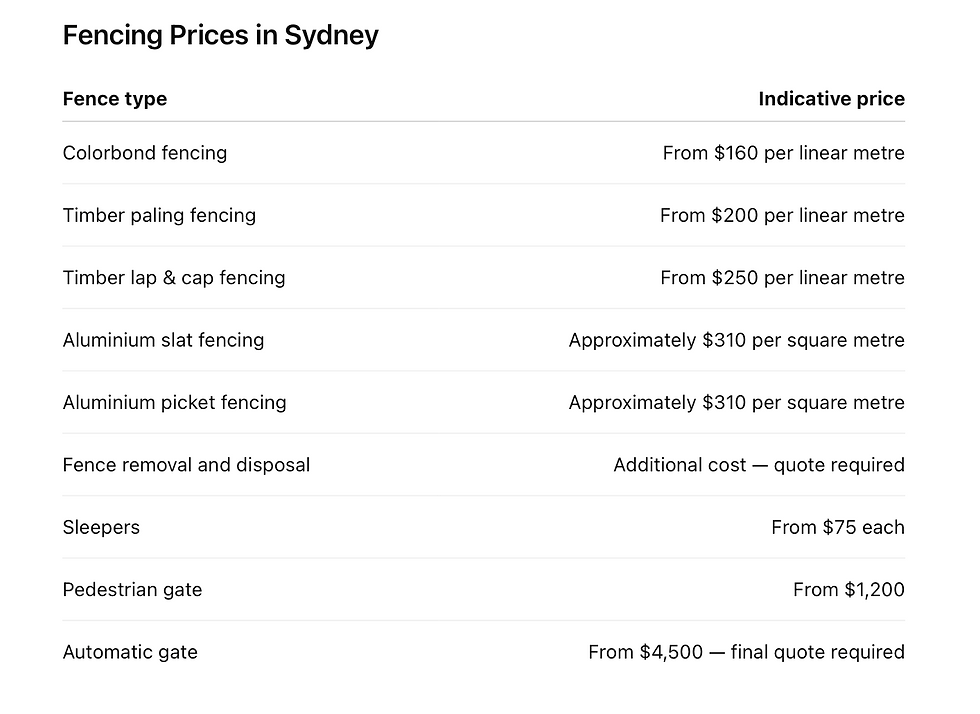
Then get a written quote describing what needs to be replaced and what the proposed new fence will cost.
That gives you something concrete to discuss with your neighbour rather than:
“I reckon the fence will cost about $5,000.”
Can I just replace it and send my neighbour the bill?
Be careful here.
Generally, dividing-fence work should be carried out by agreement between the owners or under a Fencing Order. If you simply organise non-urgent fencing work without agreement or an order, you may have difficulty recovering your neighbour's contribution afterwards. There are different rules for genuinely urgent fencing work.
So if your neighbour refuses to cooperate, don't immediately book the job and assume you'll automatically recover 50%.
Follow the process first.
step 1: get a proper written quote
This is one of the most practical things you can do.
A good fencing quote should clearly describe:
the length of the fence;
the proposed height;
the material;
demolition and disposal, if required;
the proposed fencing work; and
the total estimated cost.
Legal Aid NSW specifically recommends getting a written quote for proposed fencing work and attaching it to a Fencing Notice.
For example:
20 metres of deteriorated timber fence
Proposed replacement: 1.8 m timber fence
Removal and disposal of existing fence included
Total quoted cost: $6,000
Now the conversation isn't about somebody's guess.
There is an actual proposal and an actual price.
step 2: try to agree with your neighbour
Show them the quote.
Explain what needs replacing and what you are proposing.
Sometimes the problem isn't actually the fence — it's the price.
Your neighbour might say:
“$6,000 is ridiculous.”
Fine. They can discuss another reasonable option or obtain another quote.
Or perhaps they don't want timber and would prefer Colorbond.
Those are things you can negotiate.
If you reach an agreement, put it in writing — including what is being built, who is doing the work and who is paying what.
What if they still say “I'm paying nothing”?
Then there is a formal process available.
If you cannot agree about the fencing work, either owner can serve the other with a Fencing Notice.
This is essentially a formal written proposal saying what fencing work you want carried out and asking the adjoining owner to contribute to the cost.
The notice should contain important details about the proposed work, including its location, dimensions and materials, who will carry it out, estimated cost and how you propose the cost should be divided.
This is why having the quote ready beforehand is useful.
What if my neighbour ignores the Fencing Notice?
Ignoring it doesn't necessarily stop the process.
If one month passes after the Fencing Notice is served and you still haven't reached an agreement — including where the neighbour simply doesn't respond — either owner can apply to the Local Court or NSW Civil and Administrative Tribunal (NCAT) for a Fencing Order.
The Court or Tribunal can then deal with issues concerning the fencing work, including what fence is sufficient and how the costs should be divided.
So:
“I'm not paying.”
isn't necessarily the end of the conversation.
But what if I want a much more expensive fence?
Here's where things change.
Imagine a sufficient replacement fence would cost $4,000, but you want a premium fence costing $8,000.
You shouldn't automatically expect your neighbour to pay $4,000 simply because that's half of your preferred fence.
Where one owner wants fencing above the standard considered sufficient, that owner will usually need to pay the additional cost.
That's another reason to get a sensible, clearly specified quote.
What if the fence is dangerous and can't wait a month?
There are special provisions for urgent fencing work.
For example, a fence may have been suddenly destroyed or damaged and need immediate attention.
In some circumstances urgent work can be carried out without first obtaining the neighbour's agreement or a Fencing Order, while still potentially allowing recovery of a contribution.
But don't simply label an ordinary old fence “urgent” because you want it replaced quickly.
If you're relying on the urgent-work provisions in a dispute, consider getting appropriate legal advice.
What should I actually do?
If your neighbour refuses to contribute, don't immediately pay for everything yourself — and don't immediately start building either.
Keep it simple:
1. Document the fence Take clear photographs showing its current condition.
2. Get a written quote Know exactly what work is proposed and what it will cost.
3. Talk to your neighbour Give them the quote and try to reach a reasonable agreement.
4. Put any agreement in writing Don't rely only on a conversation over the fence.
5. If you can't agree, consider a Fencing Notice This starts the formal NSW process.
6. If there is still no agreement after one month An application for a Fencing Order may be available through the Local Court or NCAT.
Need a written fence quote to show your neighbour?
If your existing fence needs replacing, Best Fence can inspect the site and provide a detailed written quotation for the proposed fencing work.
We can assess the existing fence, measure the required work and quote suitable timber, Colorbond or other fencing options.
That gives you a clear price and scope of work to discuss with your neighbour before deciding what to do next.
Need a quote for a dividing fence in Sydney? Contact Best Fence.
This article provides general information about dividing fences in NSW and is not legal advice. Individual circumstances can differ.


Comments